
Yentl, Me, and 1983
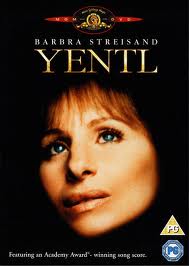
 Yesterday, April 22, Barbra Streisand received the Film Society of Lincoln Center’s Chaplin Award. In announcing the award on behalf of the Film Society, Ann Tenenbaum cited Yentl as representative of Streisand’s achievement, a “milestone film.” Yentl was the first flick to have an American woman serve as writer, director, producer, and star. But Yentl also was and is a milestone film because it gave voice, loudly and unrelentingly, to the frustrations and longings keenly felt by a generation of smart, mouthy Jewish women. Born of the old world, Yentl spoke to new world Jewish feminists.
Of course, long before Yentl, Babs had become an icon for Jewish women. A great deal of attention has been paid to the ways in which Streisand made Jewish beautiful. While some of us don’t regard her being featured on the cover of Playboy in 1977 as a compliment, her refusal of nose and surname changes have always been cause for kvelling. The drama of her hair from wild Jewfro to WASPY wisps and back again in The Way We Were struck some of us as a form of talking back to culturally dominant standards of beauty (and I know that I’m not alone in thinking that she was more beautiful before her makeover in The Mirror Has Two Faces). Those of us who hail from Brooklyn, Babs’s old stomping ground and the site of her recent Barclays Center homecoming, also felt the power of identification born of Jewish geography. But Yentl was different. That milestone film indirectly projected on-screen the experience of a generation that was confronting and transcending the impediments to living a full intellectual and spiritual Jewish life.
Yentl came out in 1983. Just a year earlier, I had been a college senior. The director of Hillel, who was also my academic advisor, recommended that I attend an institution where I would be likely to find a nice Jewish husband who would give me the Jewish children I had a responsibility to bear to counter the genocidal work of Hitler. I refrained from cursing this kosher pig out loud, but I left that office feeling at odds with my tribe and wondering whether feminism and Jewishness might be another marriage I didn’t want–or worse, couldn’t have.